Editorial Policy
Peer-reviewed articles are vital to the advancement of structured, credible, and high-quality scientific knowledge. Kertas of Health and Environmental Science (KHES) upholds rigorous peer-review standards to ensure the integrity, scientific validity, and scholarly contribution of all published work.
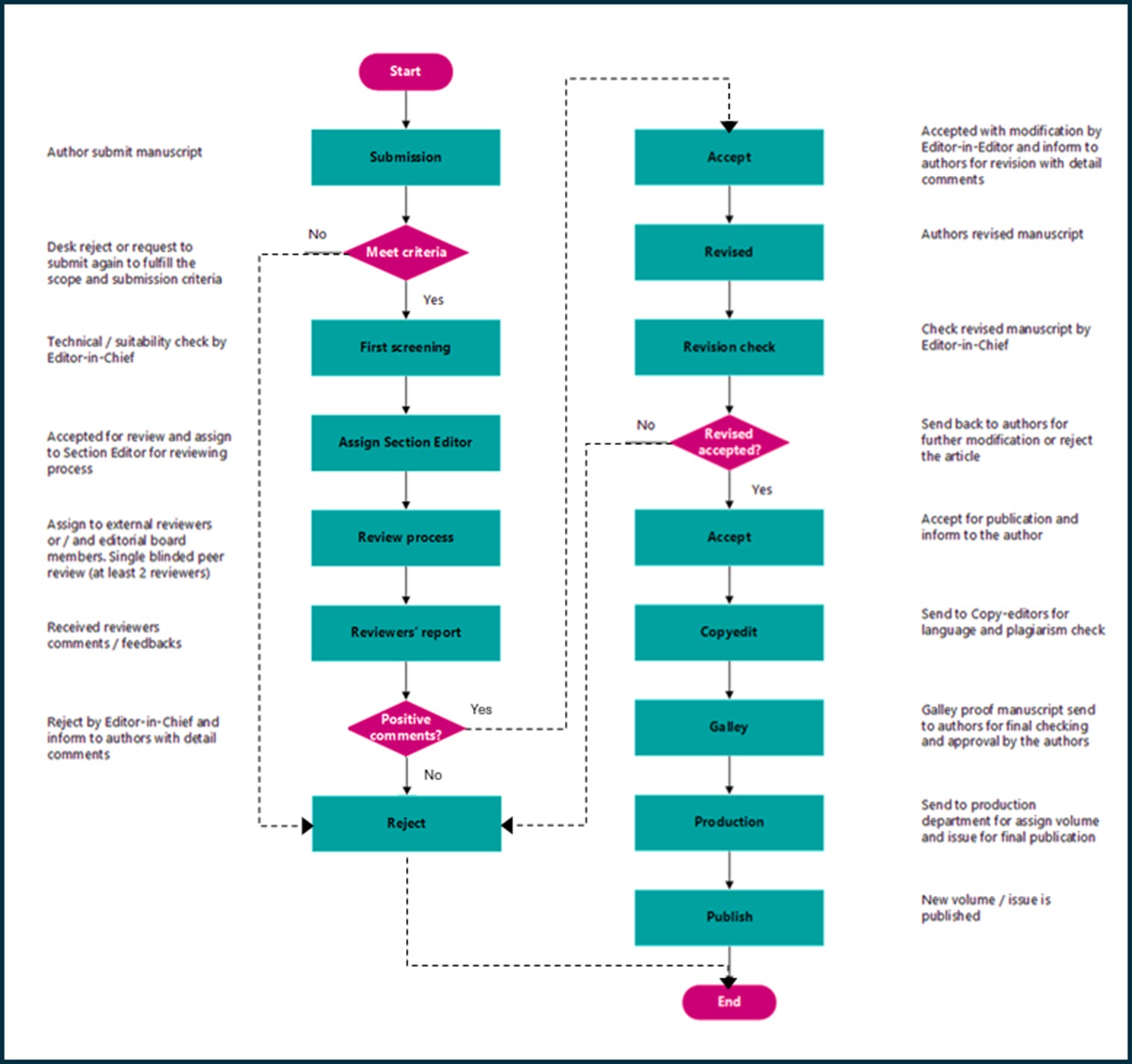
KHES uses a single-blind peer review process, where the reviewers' identities are kept anonymous, but the authors' identities are visible to the reviewers.
Initial Editorial Screening
All manuscripts undergo an initial evaluation by the Editor-in-Chief or designated Section Editors to determine their suitability for the journal in terms of:
- Scope and alignment with KHES themes in health and environmental sciences
- Originality, novelty, and scientific significance
- Methodological appropriateness and ethical compliance
- Compliance with submission guidelines and formatting requirements
Manuscripts that pass this preliminary check are forwarded for peer review.
Peer Review Process
Each manuscript is typically reviewed by at least two independent expert reviewers. Reviewers are selected based on their subject-matter expertise and familiarity with the manuscript's health, environmental, biomedical, public health, or interdisciplinary research area.
Reviewers are asked to assess the manuscript based on the following criteria:
- Originality: Novel contributions to health, environmental, or related scientific fields
- Scientific Significance: Importance and relevance of the findings and their potential contribution to knowledge or practice
- Methodological Rigor: Appropriateness of the research design, methods, analysis, and interpretation
- Ethical Compliance: Adherence to applicable ethical standards for human, animal, clinical, environmental, or biological research
- Structure and Format: Compliance with KHES author guidelines
- Relevance: Appropriateness and value to KHES readership
- Language Quality: Clear, accurate, and scholarly use of English
- Overall Merit: Scientific rigor, validity of conclusions, and overall contribution to the field
The Editor-in-Chief is responsible for the final decision regarding publication. Editors recuse themselves from handling manuscripts where a conflict of interest exists, including manuscripts involving co-authors, family members, close collaborators, institutional relationships, or relevant commercial interests. Such manuscripts are handled independently by an unbiased editorial representative.
Review Outcomes
After peer review, the Editor-in-Chief may issue one of the following decisions:
- Accept as is: The manuscript requires no revisions (rare).
- Accept with minor revisions: Limited editorial, methodological, or structural improvements are requested.
- Accept after major revisions: Substantive modifications are required in areas such as methodology, analysis, interpretation, presentation, or structure.
- Revise and resubmit: A substantially revised version may be reconsidered in a subsequent review round.
- Reject: The manuscript is declined due to major scientific or methodological flaws, ethical concerns, insufficient originality, or lack of relevance to KHES.
Reviewer comments may be edited by the editorial team when necessary to remove inappropriate language, identifying information, or confidential content. Any sensitive feedback intended solely for editors is retained within the confidential section of the review process.
Editorial Discretion
- Editors or Editorial Board members may serve as reviewers for submissions within their areas of expertise, provided that no conflict of interest exists.
- The Editor-in-Chief may seek additional expert review when the manuscript involves specialized, interdisciplinary, clinical, statistical, ethical, or methodological issues.
- Additional review may also be requested when reviewer recommendations substantially differ.
- Final editorial decisions are based on the reviewers' reports, author responses and revisions, ethical and methodological considerations, and the manuscript's overall contribution to health and environmental sciences.
Review Process Flowchart